

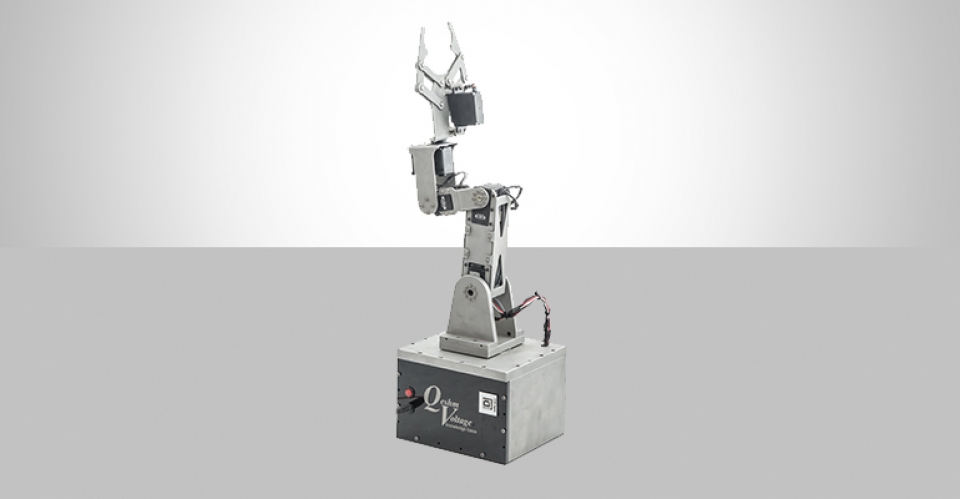
The QVR-DX51 educational and research robot was designed and built to teach advanced control systems, as well as robotics and electronics, which have extensive industrial applications.
The QVR-DX51 educational and research robot was designed and built to teach advanced control systems, as well as robotics and electronics, which have extensive industrial applications.
Purpose
In today’s industrial nations, there is intense competition to provide better solutions for controlling production processes. This has led industry leaders to use robots and equipment with high speed and precision.
Since every industrial complex requires technical and engineering support to ensure their production line, Qeshm Voltage Company is ready to equip industrial sectors to serve society and respected industrialists.
Advantages of the QVR-DX51
Its smaller dimensions make it suitable for use in educational workshops and research institutes. The use of 6000 series aluminum for the body improves the robot’s strength and reduces its weight.
This robot also allows for the analysis of torques applied to the motors and how the motors follow input commands, using its dedicated software.
This robot can be used in dynamics, mechatronics, robotics, electronics, or control laboratories.
How the QVR-DX51 is Controlled
This robot is controlled using MATLAB software and an ARM processor. All parts of the robot have undergone dynamic and static analysis using Cosmos software.
Product Specifications
|
Name
|
Code
|
Weight (KG)
|
Length (CM)
|
Width (CM)
|
Height (CM)
|
|---|---|---|---|---|---|
|
Robot Arm Training Set (DX-51)
|
QVR-DX51
|
5
|
13.5
|
53
|
16
|
Features and Capabilities
- • ARM processor
- • Five degrees of freedom
- • Light and strong body
- • Very easy to use
- • Introduction to virtual reality
- • Wireless communication with the computer
- • Torque feedback in the motors
- • Simple and accessible coding
- • A movement angle of about 0 - 360 degrees in the motors
- • Wireless connection of the robot with another robot and with the control system
- • With a dongle for communication with the computer
- • Wireless communication with other robots
- • With a multi-functional handmade board made by Qeshm Voltage
- • Introduction to ARM, LAB VIEW, MATLAB software
- • The ability to change the robot's movement easily in the simulation software
- • With 5 degrees of freedom and the robot's rotation space in J0 up to about 270 degrees
- • The ability to view the simultaneous work of the simulated robot in the computer and the real robot(s)
- • The ability to collaborate so that one robot follows another robot automatically and in REALTIME
- • The ability to work individually or collaboratively (up to more than 5 robots) in both of the above-mentioned ways, at the customer's choice